Native athletes now compete at higher levels in larger numbers; Na7ive Na7ions drives that growth further
By: Charlie Goldring
Published on January 20, 2026
PHOENIX -- Name some Native American athletes, past and present.
Jim Thorpe (Yeah, the Olympic, three-sport professional athlete; good job!). Sonny Sixkiller (Who..?). Jacoby Ellsbury (Mhm! Knew that.). Kyrie Irving (Wait, didn't know that about him…). Rickie Fowler (Well…).
Got any more?
Frankly, it's OK, if not; Native athletes rarely rise to fame, and when they do, their Native identity is often unbeknownst to the public, suggesting a sparse future.
Well, Frankly hasn't been paying attention.
The doors for Native Olympic representation are creeping open, an ultimate goal to current developments.
Former major leaguer DJ Carrasco and his wife Autumn Lopez began their work in New Zealand with business advisor Ryan Flynn, and brought it to fruition in the U.S.
They now perform efforts through their non-profit foundation, Na7ive Na7ions, to promote more access for Native athletes to further themselves in life through diamond sports (baseball/softball/alternatives).
"It's just helping Native American baseball players," Flynn said, "at every age, all across America, with opportunities and pathways and visibility for many, many years to come.
"Native American ballplayers have been," Flynn asserted, "just as big a part of baseball as any race of people since the game started in America.
"Yet people don't really know that."
While minimal historical acknowledgment suggests otherwise, Muscogee Creek Nation member Amy Jordan knows the truth.
Witnessing her son, Xander, represent the first-ever Native Nations team at the international 13 to under-16 Babe Ruth World Series in Branson, Missouri, this past August, Amy is certain:
"Natives can ball."
And now, they can ball with pride.
"Not a lot of Native athletes have an opportunity," Xander said. "It sounded like a great one for me to get out there on the field and show what I've got."
Tribal singers from the Osage Nation performed during the Babe Ruth World Series' opening ceremonies.
"We got to stand at the front," Xander added. "Me and one of my teammates, we had a Muscogee (Creek) flag around our back."
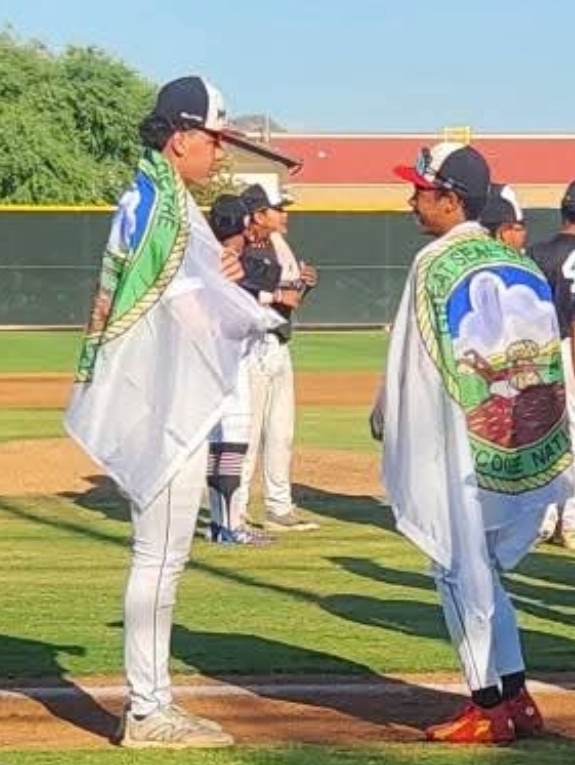
Xander and Sir Prince Mcvay holding Muscogee Creek Nation flags at the Babe Ruth World Series opening ceremonies. (Photo Courtesy of Amy Jordan)
"I probably won't ever forget that," Native Nations player and Navajo Nation member Seth Bennalley said.
"It was just fun to be a part of the first Native team to ever go to this," Bennalley added, "and for sure, we won't be the last."
The Native Nations National Team was selected after the first-ever Na7ive Na7ions tournament, held this past July in Arizona, and attended by more than 160 Native 13- to 16-year-olds across more than 40 Nations from the U.S. and Canada.
The tournament, scheduled to repeat this coming June, was held at the Salt River Fields at Talking Stick, the spring training home for the Colorado Rockies and Arizona Diamondbacks.
Carrasco designed Na7ive Na7ions to allow young Native athletes a belief in a promising future through diamond sports with sustainable efforts both on and off the field. The '7's come from the Haudenosaunee philosophy that every decision today affects the next seven generations, with many related Native perspectives.
"I've never been a part of something where there's never been a naysayer," Carrasco said. "I just haven't found that person yet.
"It makes all the sense in the world… why haven't we done this 60 years ago, right?"
Carrasco has a point. Native talent's always been there. There just haven't been channels like the ones he is now building.
Karuk Tribe Chairman, Russell 'Buster' Attebery, wasn't noticed growing up. Attebery, a catcher, was drafted by the San Francisco Giants in 1970.
"When I finally got to Sacramento State," Attebery reminisced, "my coach said that I probably have one of the best throwing arms in all of college baseball, and you know that's the first time,
"I never knew how to compare."
Attebery didn't receive offers out of Happy Camp High School in remote Siskiyou County, California. He capped off his baseball career with former Bonanza actor and Kurt's father, Bing Russell's, independently-owned Portland Mavericks, a team filled with misfits and has-beens that saved independent baseball in America.
Attebery and hundreds of others watched his great-nephew, Mason Snopl, perform at the Babe Ruth World Series in August.
Remember Joba Chamberlain? Former Yankees pitcher, who jumped on the scene in 2007 with a wicked slider and dominant fastball?
Yes, the midges in Cleveland, those little bugs crawling all over that Yankees pitcher's face during the playoffs.
Chamberlain, a Ho-Chunk Nation member, is one of eight Native American professional baseball players since 1988.
He sees a brighter future because of the light that Na7ive Na7ions shines on young Native athletes.
"I get excited," Chamberlain said, "this next generation hopefully, and will, have an opportunity to (represent Native Nations on an Olympic level).
"There's so many before us that paved the way in a different way, and now we have an opportunity to pay it forward."
"It's weird to me," Chamberlain added, "that Native Americans aren't talked about very much, and I think a lot of people are now opening their eyes.
"Programs like this," Chamberlain continued, "are meant to be able to teach, to educate and put the world in a better place and to give opportunities that maybe they don't have. And that's the best thing about this.
"If you find the right people who are willing to put in the time and the effort then it can go a lot of places."
It's happening beyond baseball, too.
NCAA data reveals Native athletes rose 35% in 2024-2025 from 2014-2015. During the same period, overall athlete participation increased by 17%, indicating Native American participation in college sports is increasing at an accelerated pace compared to other demographics.
Shiyazh Pete, a University of Kentucky offensive lineman, is paving ways in the Southeastern Conference, inspiring more Native football players with the visibility he receives competing in the SEC.
"Native athletes," said N. Levi Esquerra, Na7ive Na7ions board president and former Chairman of the Chemehuevi Indian Tribe, "were never given the opportunity to really be seen at that level.
"Now there's pathways in place," Levi Esquerra continued, "for them to be seen by the right people. I mean colleges, universities, major league scouts, you know there's opportunities now that may not have been before.
"This [Na7ive Na7ions] will truly be a pathway, and the hope is that one day, when you pick up a baseball card, on the back, it's going to say your tribe."
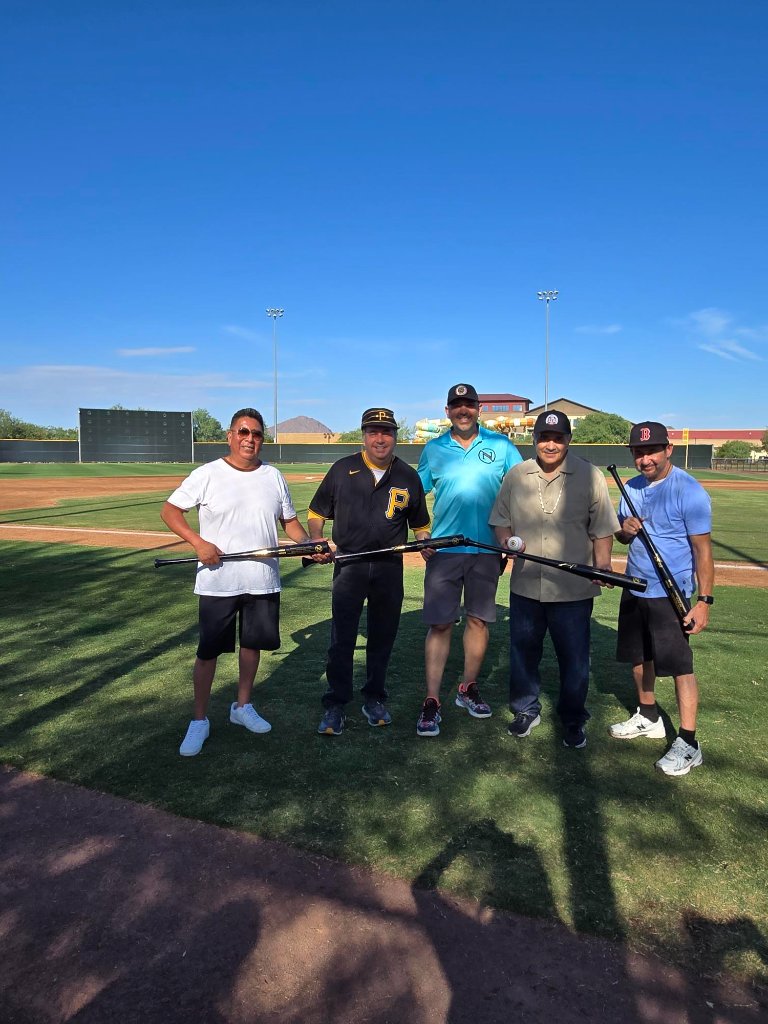
DJ Carrasco centered, N Levi. Esquerra in the P jersey (Photo Courtesy of N. Levi Esquerra)
Why not utilize resources to grow this further, when the desire and talent is there?
"It's a community that's been treated like garbage for a long time," Flynn said. "It's no secret how Native Americans were treated, pushed on to reservations and pieces of land no one wanted.
"Does anybody not know this?"
"So anything you can do to push these kids forward," Flynn continued, "who were basically pushed into a corner and living on a system of handouts and B.S.
"Then why wouldn't you do something when all these kids want to play our country's pastime at a higher level and need the assistance and resources to uplift themselves."
This won't just open more doors in athletics, this will create exposure to entirely new possibilities.
Research suggests implementing athletic programs on Native reservations will improve health, education and community well-being for Native communities.
Reality is showing exactly that.
Na7ive Na7ions co-founder and Nutritional Therapy Practitioner, Autumn Lopez, created Home Plates, a program designed to help athletes better understand dietary needs for overall health and wellness and to extend that foundational knowledge to their families and communities.
"'I want them to learn holistic nutrition,'" Lopez said of Carrasco, describing Na7ive Na7ions' developmental evolution. "'I want them to learn a different way of life, things that they can do for themselves and their communities, and then I want them to be amazing athletes.'"
Anyone who participated in the Na7ive Na7ions tournament in Arizona received a three-week nutrition plan for before, during and after the tournament, to help them prepare, endure and recover.
"We really leave an open space, too," Lopez added. "These kids can come talk to us afterwards, their parents could come talk to us.
"And then on the outside, to get off the field, we sit with the communities, 'What can we do, where can you invite us in to come and share health tips.'"
All of this action generates momentum to a more vibrant present and future.
"We are creating history," former Robinson Rancheria Tribe Chairman Beni Cromwell said. "That's what's so special about this. It's never been done before, having an Indigenous team, and I think it can grow bigger and better."
Forging history extends beyond sports.
"It starts to really see tribes as Native nations," Levi Esquerra said, "as sovereign nations, as truly our own. It's all the non-Native communities recognizing tribes as their own. That is probably one of the biggest things I see happening."
So, what will it take to continue this progress?
For Carrasco's plan to grow into the training hubs in Native-concentrated areas he envisions, there needs to be serious financial backing.
"I'm not built to ask for money, man," Carrasco said, "I don't like doing it, but I had to do it Year 1 to get this thing going.
"It's gotta be done."
This isn't a dream. There is real interest and activity on several levels: players, coaches, families, communities, professional athletes [current and former], board members and international governing bodies; the World Baseball and Softball Confederation approved Na7ive Na7ions as an associate member in July.
It's just missing one thing:
"I'd love to see Fortune 500s chiming in," said Linda Imonti, Na7ive Na7ions board member and former KPMG Managing Principal.
"It's been slowed by our current climate," Imonti continued. "Corporates have really had to rethink how they do all of their DEI programs this year and what those look like, and that puts a hold on a lot of capabilities they might have about investing in something like this.
"There have been a lot of responsible corporations," Imonti said, "that have had to take a look at how, where and why they do these things. They have a responsibility to themselves as an organization to make sure they're abiding by all of the legal and other requirements."
This hasn't stopped the Rawlings sporting goods company from providing equipment for Na7ive Na7ions.
"They basically said come to us with your needs," Carrasco explained, "and we'll see how we can help. There's no dollar amount attached to it or parameters, if they can help, they will, which is an absolutely amazing relationship to have."
Rawlings supplied over 200 baseballs for the Na7ive Na7ions tournament and Babe Ruth World Series Native Nations team, as well as bases, bags and bats, according to Carrasco.
"I think a lot of people took a timeout," Imonti said, "a lot of your corporates, and as we get into next year, I think we will see some of that shift."
Perhaps Fortune 500 companies will get involved as they see evidence and momentum mounting from Na7ive Na7ions.
Then the initial list won't be as hard to come up with.
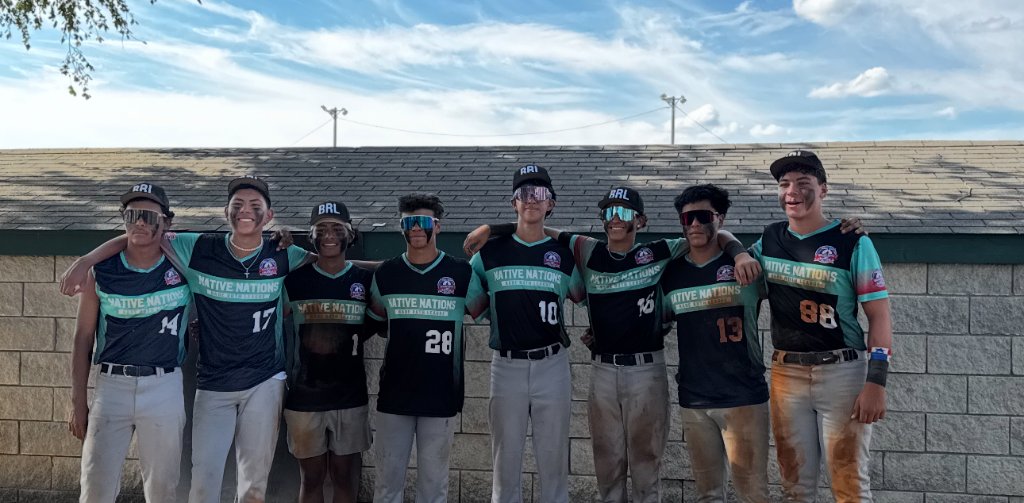
L-R Nabaahi Brooks, Jace Huma, Nathaniel Benavidez, Mason Snopl, Seth Bennalley, Joey Lyons, Eliyas Bradley-Barton, Michol "Xander" Jordan (Photo Courtesy of Melissa Caddell)
Xander Jordan (Muscogee Creek), Seth Bennalley (Navajo) and Mason Snopl (Karuk) might be household names; perhaps one of their teammates or the many other Native athletes who have and will continue to benefit from Na7ive Na7ions and programs alike.
"Next year we're going to have a softball team," Levi Esquerra said, emphasizing this movement's impetus. "This goes way beyond baseball and softball,
"This goes to truly impacting our Native nations."